A lot of buyers think the hard part is finding a buyer’s agent.
It usually is not.
The hard part is working out which one is actually the right fit for your budget, location, property type, and buying style.
That is where people get caught. One agent sounds confident. Another has a polished Instagram. Another says they have off-market access. Another talks a lot about negotiation. Suddenly you are comparing personalities instead of process.
Here’s the catch. A buyer’s agent is not just someone who opens doors and sends listings. They are part researcher, part filter, part negotiator, and part project manager. If the fit is wrong, the process gets messy fast.
So what does that mean in plain English?
If you want to know how to choose a buyer’s agent, start by comparing what they actually do, where they actually buy, and how they actually charge.
What buyers usually get wrong
Most buyers make one of these mistakes first:
-
They pick the first agent who sounds switched on
-
They focus on confidence instead of local experience
-
They never ask what is included in the fee
-
They do not check whether the agent works with owner-occupiers, investors, or both
-
They assume every buyer’s agent covers every suburb equally well
-
They treat “off-market” like a magic word
We’ve seen this play out when buyers are already tired from open homes, worried about missing out, and keen to hand the whole thing over. Fair enough. The process is time-consuming.
But this is also when poor-fit decisions happen.
What a buyer’s agent should help with
A buyer’s agent is a licensed professional who represents the buyer, not the seller. BuyerAgentFinder’s own guides and directory pages position the service around comparing agents by expertise, fees, and local knowledge, which is exactly how buyers should think about the choice.
A typical scope may include:
-
brief and budget review
-
suburb and search planning
-
shortlisting properties
-
inspections and appraisals
-
auction bidding or private treaty support
-
negotiation
-
due diligence coordination, such as contract review and building and pest checks
-
help through exchange and settlement
That does not mean every agent includes every step. This is why comparing side-by-side matters.
Don’t pick a buyer’s agent on vibes
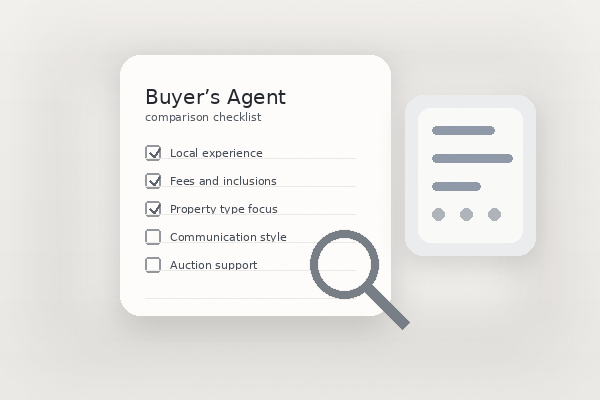
Use this quick checklist instead.
Local experience
Can they point to recent buying activity in your target city, region, or suburb cluster?
Property type fit
Do they mainly buy family homes, units, prestige homes, development sites, or investment stock?
Buying approach
Are they data-led, relationship-led, auction-heavy, or negotiation-first?
Communication style
Will they update you daily, weekly, or only when there is a short list?
Fee structure
Is it a fixed fee, percentage fee, retainer plus success fee, or staged fee?
Service scope
Do they help with suburb shortlisting, pre-auction due diligence, contract review coordination, and bidding?
Capacity
How many active clients are they handling right now?
Compare buyer’s agents side-by-side
Fee clarity box
Now, the part most people miss.
“Fee” is not the full question. The real question is:
How do they charge, what’s included, and what is not?
Common fee structures
-
Fixed fee: one set amount for the service
-
Percentage fee: a percentage of the purchase price
-
Retainer: upfront payment to begin the search
-
Success fee: paid when the property is secured
Ask specifically what is included
-
suburb research
-
inspections attended
-
auction bidding
-
negotiation
-
due diligence coordination
-
contract review coordination
-
post-offer support
Ask what may cost extra
-
travel outside the main area
-
extra inspections
-
weekend auction attendance
-
specialist reports
-
extended search periods
For broader reading, a natural next step is to browse BuyerAgentFinder’s finance articles and property articles
before you compare again.
Red flags and green flags
Green flags
-
Clear explanation of service scope
-
Specific suburb or region knowledge
-
Honest answer about where they are strong and where they are not
-
Transparent fee structure
-
Practical process for auctions, private treaty, and due diligence
-
Comfortable working alongside your broker, solicitor, or conveyancer
Red flags
-
Vague claims with no examples
-
Hard sell before understanding your brief
-
Unclear fees
-
“We can buy anywhere” without detail
-
Big focus on brand and very little on process
-
No clear answer on communication frequency
-
Pushy language around speed without explaining the risk checks
Copy-paste questions to ask a buyer’s agent
You can send this by email or use it on a call.
-
Which suburbs or regions do you buy in most often?
-
Do you mainly help owner-occupiers, investors, or both?
-
What property types do you buy most often?
-
What is your fee structure, and what exactly is included?
-
What costs could sit outside your quoted fee?
-
Do you help with auction bidding and private treaty negotiation?
-
How do you assess fair value before making an offer?
-
How often will you update me?
-
How many active clients are you managing right now?
-
What does your process look like from enquiry to settlement?
A quick scenario
Say you are a time-poor Sydney upgrader. You have pre-approval, a rough suburb list, and no spare weekends.
One agent may be a good fit because they know your target pocket, handle auctions well, and give structured weekly updates.
Another may still be a strong agent, just not for you. Maybe they are more investor-focused. Maybe they cover too broad an area. Maybe their fee looks lower but excludes key parts of the process.
That is why “best buyer’s agent” is the wrong question.
The better question is: Which buyer’s agent is the best fit for this purchase?
If you are buying in NSW, start with the NSW buyer’s agents directory. If your search is Sydney-specific, go straight to Sydney buyer’s agents.
Process map
Here is the simple version:
Compare → shortlist → enquire → meet agents → choose
That is also how BuyerAgentFinder frames the journey on its main site: compare options, learn how they work, then connect with shortlisted agents.
What to do next
If you’re thinking, “Okay, but what should I do?”, start here:
-
Write down your buying brief in one paragraph
-
List your must-haves and trade-offs
-
Shortlist 2 to 3 buyer’s agents only
-
Compare fees, local experience, and inclusions side-by-side
-
Ask the same questions to each agent
-
Verify details directly with the agent before deciding
Read more:
Next step: Shortlist buyer’s agents by fees and services
BuyerAgentFinder is a comparison and introduction service. Information is general and does not consider your personal situation. Confirm fees, services, and suitability directly with the buyer’s agent.